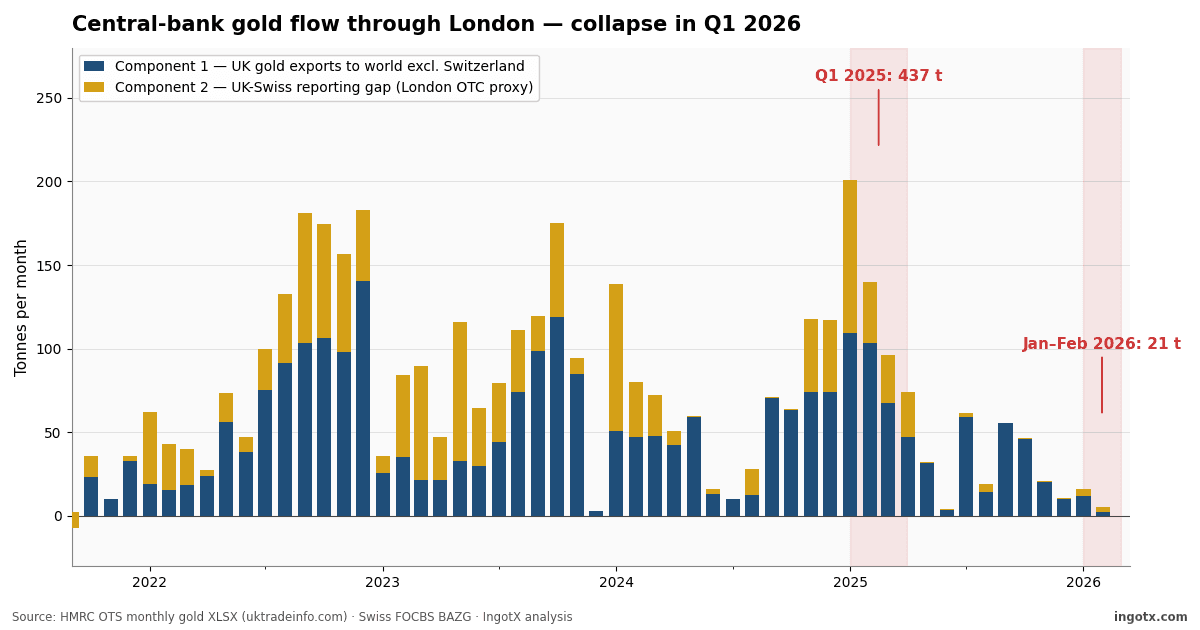
Central bank gold flows routed through the London market collapsed to their lowest level in four years in early 2026, according to UK customs data analysed by IngotX, even as the World Gold Council reported global central bank demand rose to 243.7 tonnes in the first quarter. Combined UK gold bar exports to non-Swiss destinations plus the UK–Switzerland reporting gap — the two components of the Goldman Sachs nowcast for unreported sovereign buying — totalled just 21 tonnes across January and February 2026, down 94% from the 340.7 tonnes recorded in the same two months of 2025.
The divergence between London-channel data and the WGC's Q1 2026 print (gold.org, Gold Demand Trends, Q1 2026) is the widest IngotX has measured since beginning monthly tracking of the bilateral UK–Swiss flow in 2021. WGC reported Q1 2026 central bank and other institution demand at 243.7 tonnes — up 2.8% year on year and the highest quarterly print since Q4 2024 (366.6 tonnes). The London-channel nowcast points in the opposite direction.
For the full quarter of Q1 2025 the IngotX nowcast registered 437 tonnes of central bank flow through London — split between 280 tonnes of UK gold exports to destinations outside Switzerland (Component 1) and a 157-tonne gap between UK-recorded exports to Switzerland and Swiss-recorded imports from the UK (Component 2). The Jan–Feb 2026 reading is 14 tonnes and 6.8 tonnes respectively. Even on the optimistic assumption that March 2026 doubles the partial quarter, full Q1 2026 would still land near 42 tonnes — roughly 17% of the WGC global figure for the same quarter, and the weakest start to a year in the dataset since Jan–Feb 2021.
The Two Channels That Have Gone Quiet
Component 1 — UK gold bar exports to all destinations excluding Switzerland — is the cleaner read on direct sovereign shipments from London vaults to emerging-market central bank vaults. The HMRC monthly Non-Monetary Gold country breakdown shows two specific corridors driving the collapse.
| Destination | Jan–Feb 2025 (tonnes) | Jan–Feb 2026 (tonnes) | Change |
|---|---|---|---|
| Jordan | 128.3 | 0.03 | −99.98% |
| China | 50.0 | 10.0 | −80.0% |
| Bulgaria | 15.9 | 0.0 | −100% |
| Singapore | 2.5 | 0.03 | −99% |
| All other ex-CH | 15.8 | 4.3 | −73% |
| Component 1 total | 212.5 | 14.4 | −93% |
Source: HMRC OTS monthly gold XLSX, CN 71081100/12/13xx, 71090000, 71123000, 71129100. IngotX analysis.
The Jordan line is by far the most striking. UK gold exports to Jordan ran at 0–1 tonne per month for most of the past decade, then jumped to 89 tonnes in January 2025 and 39 tonnes in February 2025 — a 128-tonne, two-month pulse widely read at the time as a routing for an undisclosed Gulf sovereign buyer. That pulse has not recurred; Jan and Feb 2026 combined are 30 kilograms.
Component 2 — the gap between UK-recorded exports to Switzerland and Swiss-recorded imports from the UK — has also evaporated. This wedge averaged 36 tonnes per month across 2022–24 and 28 tonnes per month in Q1 2025. Over the last nine months (June 2025 to February 2026) the wedge has averaged 1.4 tonnes per month, and three of those nine months were negative. This is the channel most closely associated with bullion-bank-mediated central bank purchasing in the London OTC market, and on this measure it is effectively dormant.
Where the Gold Is Going Instead
The WGC and IngotX figures are not measuring the same thing, and the gap between them implies something important about the structure of 2026 central bank demand. WGC's Q1 2026 total of 243.7 tonnes (World Gold Council, Gold Demand Trends, Q1 2026) captures all official-sector buying regardless of channel — IMF-reported additions, Metals Focus's estimates of unreported flow, sovereign-wealth vehicle reclassifications, and domestic mine offtake by central banks in producer states.
The IMF International Financial Statistics May 2026 release (data.imf.org) shows the reported picture is dominated by buyers who source gold outside the London market: Poland (+133 tonnes since year-end 2024), Kazakhstan (+70 tonnes), China (+34 tonnes through March 2026) and Uzbekistan (+33 tonnes). Of these four, only Poland is a meaningful customer of LBMA vaults — and even Polish buying does not typically register in the UK–Switzerland flow because the National Bank of Poland imports directly via Frankfurt and Bank of England custody transfers. Kazakhstan, China and Uzbekistan have publicly stated programmes to absorb domestic mine production directly, bypassing LBMA entirely.
Two further line items in the IFS snapshot account for most of the remaining net change: Azerbaijan appears at 178 tonnes (versus zero at year-end 2024), almost certainly a reclassification of State Oil Fund holdings onto the central bank balance sheet rather than fresh market buying, and Brazil reports +43 tonnes on a similar reclassification pattern. Stripping out these accounting events, transparent Q1 2026 buying by IMF reporters is on track to be the smallest quarterly figure since 2020.
The same IFS file confirms two material sellers — Turkey (−53 tonnes since year-end 2024) and Singapore (−26 tonnes) — both former London-market buyers. CBRT's pivot from net buyer to net seller is the single largest behavioural change in the official sector this cycle and removes another major source of London-vault throughput.
What to Watch in the June HMRC Release
The next test of this thesis will be the HMRC March 2026 release, due in early to mid June 2026 on uktradeinfo.com. The two specific signals to monitor are whether the UK → Jordan corridor reopens (a clean tell on continued Gulf sovereign routing through London), and whether the Swiss FOCBS February 2026 file (bazg.admin.ch) confirms or revises the near-zero Component 2 reading. February 2026 HMRC data carries IngotX's provisional flag and is the most likely month in the table to be revised upward when finalised.
For the bullion market, the operational implication is that LBMA vault throughput from the sovereign side is running at a fraction of last year's pace. Independently, LBMA's published vault holdings have continued to grow through Q1 2026 — the absence of central bank offtake is consistent with that build. If the WGC's headline number is to be reconciled with what UK and Swiss customs are showing, the residual is now overwhelmingly domestic-mine and direct bilateral flow that bypasses London entirely. That is a structural rather than a cyclical change, and it is the most significant development in the sovereign gold market since the 2022 acceleration that followed the freezing of Russian central bank reserves.
Methodology
UK gold export data is sourced from the HMRC monthly Non-Monetary Gold country breakdown XLSX supplement (uktradeinfo.com), covering CN-8 codes 71081100, 71081200, 71081310/80, 71090000, 71123000 and 71129100, summed across all reported destinations. Mass in kilograms is reconstructed from reported GBP value using monthly LBMA-tracker gold prices (COMEX GC=F ÷ GBPUSD=X) where HMRC's NetMass field is suppressed. Swiss import data is sourced from the Swiss Federal Office for Customs and Border Security (BAZG), file TN8_controlCode_Gold_IMP_en_v1.csv via ocean.nivel.bazg.admin.ch, filtered to Country_isoAlpha2 == 'GB'. The IngotX central bank nowcast follows the methodology described in Goldman Sachs, Precious Analyst — Gold Market Primer (17 August 2025). World Gold Council figures are taken from Gold Demand Trends, Q1 2026 (data as of 31 March 2026). IMF figures are taken from the International Financial Statistics World Official Gold Holdings release, May 2026. February 2026 HMRC data is flagged provisional and subject to revision. BAZG country tagging reflects country of origin, not country of consignment; Component 2 is therefore a lower bound on the corresponding consignment flow.
Sources: HMRC OTS (uktradeinfo.com) | World Gold Council (gold.org) | IMF International Financial Statistics (data.imf.org) | Swiss FOCBS / BAZG (bazg.admin.ch) | Goldman Sachs Gold Market Primer, August 2025
